How Does the Shrink Ratio of Heat Shrink Molded Boots Affect Product Selection?
When purchasing heat shrink molded boots, many buyers first pay attention to the product size and material type, but what really affects the installation and matching effect is how much the product can shrink and whether it can stably fit into the protected area after shrinking. If the shrinkage ability of the heat shrinkable molded sleeve does not match the outer diameter of the cable and the size of the connection structure, problems such as being too loose, insufficient shrinkage, or even local failure to fit after installation may occur. Therefore, understanding the shrinkage ratio and radial shrinkage performance is very important for purchasing heat shrink molded boots of the right size.
What Is the Contraction Ratio of a Heat Shrink Transition Breakout?
The shrinkage ratio of a heat shrinkable product is often used to describe the range of size change of the material before and after heating. For example, the common 2:1 shrinkage ratio can be understood to mean that after the product is heated and shrunk under specified conditions, its radial size can be reduced to about half of the original size. Taking diameter as an example, if the theoretical shrinkage ratio of a product is 2:1, it means:
· Have a large inner diameter before shrinking and can be inserted into the protected area;
· The inner diameter decreases significantly after heating;
· The shrunk size needs to form a reasonable fit with the actual cable or connection area.
The 3:1 shrinkage ratio means that the product has a larger range of size changes and can cover a wider protected size range. However, for heat-shrink molded sleeves, we cannot only focus on "2:1 or 3:1" when purchasing but also need to consider the branch structure, end size, size changes in different directions, and length changes after shrinkage.
Why Does Shrinkage Ratio Affect Product Selection?
Assuming that there is a significant size change in the cable connection area that the buyer needs to protect, if the size of the product before shrinkage is too small, it may not be able to fit smoothly during installation; if the initial size of the product is too large and the product lacks sufficient radial shrinkage ability, it may not be able to fully fit after heating.
Therefore, when selecting a heat shrink molded sleeve, two critical sizes need to be confirmed at the same time.
1. Is the pre-shrink size sufficient
Products need to be able to bypass cables, connectors, or splice areas smoothly before shrinking.
Especially when there is a large connection structure, the product cannot be selected only based on the cable conductor specifications, but the maximum outer diameter of the entire area that needs to be inserted should be measured.
2. Whether the shrunk size is suitable
After the product is completely shrunk, it should be able to maintain a reasonable fit with the actual protected area, rather than just "being able to put it on".
This is why buyers cannot place orders directly based on product name or cable model but should provide suppliers with the actual maximum outer diameter, minimum outer diameter, length, and structural information of the protected area.
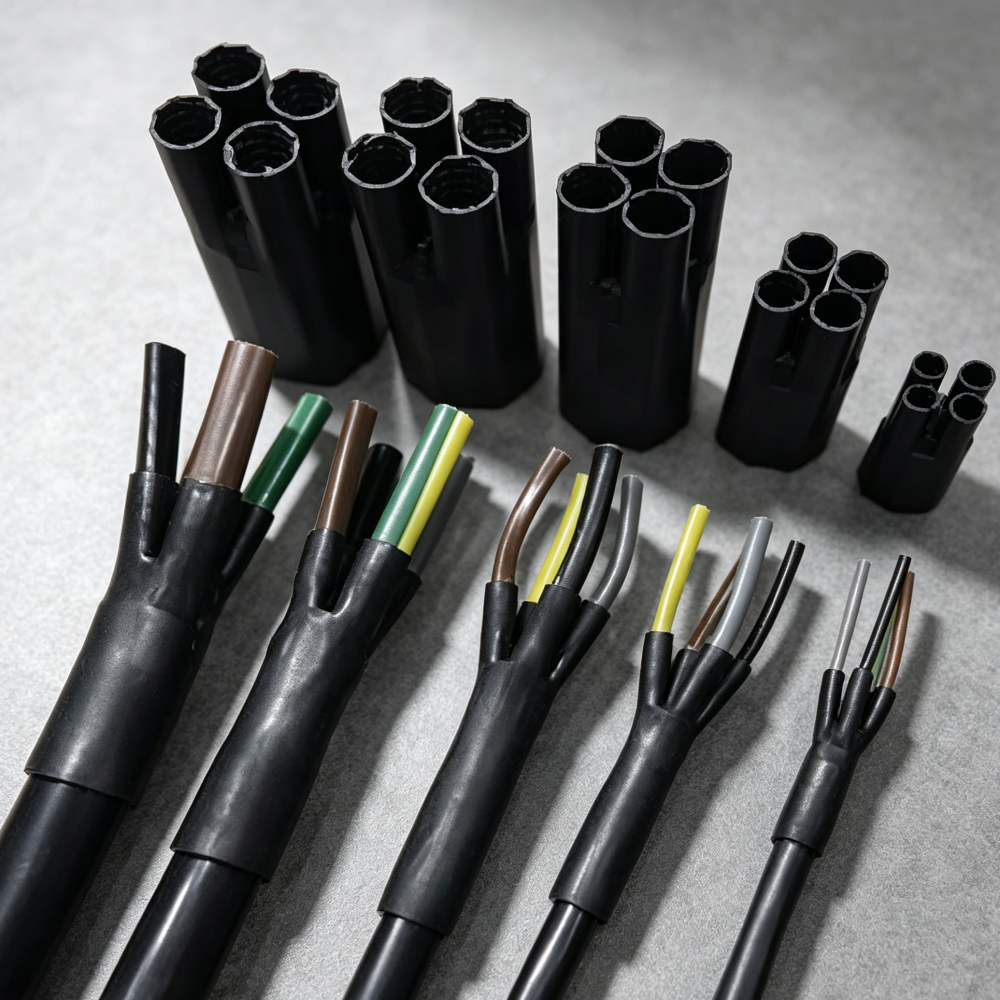
How should I choose 2:1 and 3:1 shrinkage ratios? If the size of the protected area is relatively uniform and the structure is relatively simple, the small shrinkage range can already meet the actual requirements. For cable connections with large changes in size or areas with relatively complex structures, a larger shrinkage range can usually provide a wider installation matching space. It can be simply understood as the following:
| Shrink Ratio | Key Features | Scenarios Suitable for Consideration |
| 2:1 | Relatively limited range of dimensional variation | Connection areas with minimal dimensional variation and regular geometry |
| 3:1 | Broader range of dimensional adaptability | Connection areas or cables exhibiting significant dimensional changes |
| Higher Shrink Ratio | Capable of accommodating larger dimensional differences | Requires verification based on specific product data and the actual structure |
In the actual selection, the buyer should further confirm the actual radial shrinkage rate and axial change rate of the product.
How to Confirm the Actual Shrinkage Performance of Heat Shrink Molded Boots?
Instead of just asking the supplier, "Is this product 3:1", the buyer should ask the supplier to provide actual product test data.
Supported by Changchun Chemistry Technology Co., For example, the heat shrink transition breakout from Ltd. has a radial change rate of ≥50%(150±2℃, 1 to 3 minutes). This data can help buyers determine the radial size change ability of the product under specified heating conditions.
At the same time, our heat shrink molded boots have a longitudinal change rate of ≤10%. This parameter is also worthy of attention. Because during the heat shrinkage process, if the product changes excessively in the length direction, it may cause the originally determined coverage area to shift and affect the final installation effect.
Therefore, when confirming product specifications, it is recommended that buyers also check:
· Pre-shrink size;
· Shrink size;
· Maximum outer diameter of protected area;
· Minimum outer diameter of protected area;
· Product radial shrinkage;
· Vertical product change rate;
· Recommended shrinkage temperature;
· Actual coverage length after installation.
Shrinkage Performance Is Not the Only Selection Criterion.
In long-term operation of wire and wiring harness connection areas, size matching is only the first step in product selection. If the heat-shrink molded sleeve can be shrunk to a suitable size, but the flexibility of the material is insufficient, the performance is reduced after long-term heating, or the electrical insulation capacity cannot meet the project requirements, it will also affect actual use.
For example, the tensile strength of this heat shrink transition breakout is ≥14.0 MPa, the elongation at break is ≥500%, and the Shore hardness is ≤ ≤70A. A higher elongation at break means that the material has a certain elongation ability and can adapt to certain deformation in the wire connection area during installation and actual use.
In addition, CCMT's heat-shrink molded sleeve also passed the -55 ± 2°C low-temperature bending test and the 250 ± 1°C thermal shock test, and there was no cracking under the specified test conditions.
For equipment that requires long-term operation, thermal aging performance is also worthy of attention.
After undergoing thermal aging testing at 175±1°C for 168 hours, our heat-shrink molded sleeves have retention rates of both tensile strength and elongation at break ≥70%, which can be used as a reference for buyers to evaluate the material's thermal aging ability.
Electrical Insulation Performance Also Needs to Be Included in the Procurement Evaluation.
If a heat shrink transition breakout is used in live or electrically connected areas, then the shrinking fit effect is only one aspect. The electrical insulation properties of the product itself also need to meet the project requirements.
CCMT's heat shrink transition breakout:
· Dielectric strength ≥ 20 kV/mm
· Volume resistivity ≥1.0×10¹³Ω·cm
· Dielectric constant ≤3.5
Can be used for insulation protection of wire connections, wiring harness branches, and local connection areas.
Therefore, when comparing products from different suppliers, buyers can combine size adaptability, mechanical properties, and electrical properties to evaluate rather than simply comparing product prices or shrinkage ratios.
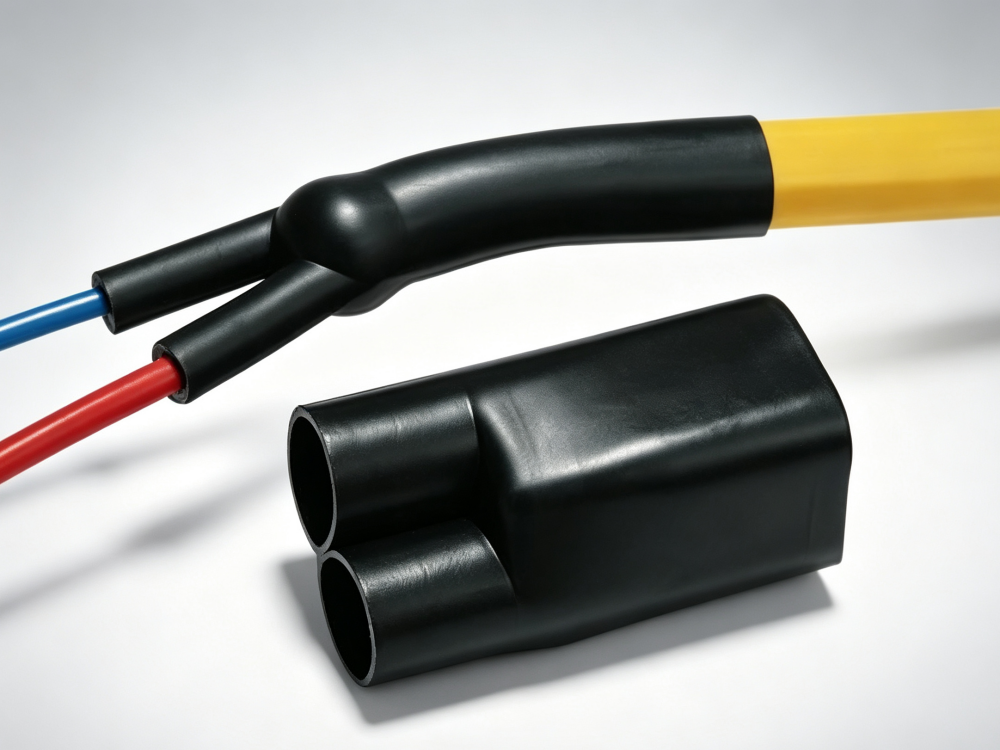
What Size Information Should Be Prepared Before Purchasing?
If you are purchasing a heat shrink transition breakout for a specific project, it is recommended to prepare the following information before making an inquiry.
1. Measure protected areas: Provide the maximum and minimum outer diameters of cables, wiring harnesses, or connection areas.
2. Confirm the connection structure: If the product is used for branch connection, the number, size, and outgoing direction of main lines and branch lines need to be explained.
3. Identify the length that needs to be protected: Clarify where to start protecting and where the product needs to be covered.
4. Check shrinkage performance: Provide data such as radial shrinkage rate, axial change rate, and recommended shrinkage temperature.
5. Confirm the use environment: working temperature, low-temperature performance, thermal impact, flame retardant, and long-term aging performance.
6. Confirm whether electrical performance, dielectric strength, volume resistivity, and other indicators meet the insulation requirements of the project.
Don't Choose Heat Shrink Transition Breakout Based Solely on the Contraction Ratio.
Shrinkage ratio is an important reference for judging the ability to adapt to the size of the heat-shrink molded sleeve, but it is not the only basis for selection. The truly effective selection method is to combine the size before shrinkage, the size after shrinkage, the structure of the protected area, and the material properties.
This heat shrink transition breakout meets military specifications and can be used for wire connections, wiring harness branching, and local connection protection in public transportation, military equipment, commercial ships, and industrial electrical equipment. If you are also interested in cable accessories, you can provide us with the size information, and we will match the right product for you.