How to Select Medium Wall Heat Shrink Sleeves in Cable Joint Applications?
In the process of selecting heat shrink tubing, whether the specification matches the joint structure is a concern for most buyers. The same medium wall heat shrink sleeves have different specifications for different cable outer diameters, joint size and installation space. Confirming several key size and use conditions before placing an order can reduce problems of wrong specification selection, installation mismatch, and subsequent rework.
Don't Purchase Based Solely on the Cable Model.
The cable model can help suppliers understand the product type, but it cannot directly determine the heat shrink tube specification. Cable joints usually have areas with different diameters such as terminals, connecting pipes, and insulation layers. In fact, knowing the actual physical dimensions available for the installation of a joint is more helpful when purchasing.
It is highly advised to supply at least:
· Real diameter of the cable;
· biggest outside diameter at the joint position;
· length which must be shielded;
· whether steps or other odd shapes are present;
· whether the place of installation has space limitations.
This kind of information is a more realistic way of a supplier making specifications match, rather than relying only on an individual cable model.
Pay Special Attention to the "Maximum Outer Diameter" Position.
The problem is that when selecting heat shrink tubing most specifications are incorrect. It is usually not that the size of the cable is badly measured that leads to this kind of situation but rather that the maximum outer diameter of the whole assembly has not been taken into consideration.
For example, heat shrink tubing needs to be slipped over a larger size connection, but eventually needs to be shrunk to a smaller cable jacket surface. Besides the diameter of the cable body, only the use of one criterion for selecting the product is likely to result in "it can shrink, but during installation, it will not fit through".
Therefore, when confirming the specifications, the purchaser should also check:
Whether it can be inserted before installation, wrapped after shrinking, and whether the shrunk size is suitable for the installation space.
This is one of the reasons why high shrinkage ratio heat shrink tubing is of practical value in complex joint structures.
The Length Also Needs to Be Confirmed in Advance.
Compared with diameter, length issues are sometimes more easily ignored in purchasing.
After installation, the heat shrink tube needs to cover the complete joint area, while leaving a reasonable overlap range at both ends. If the length is insufficient, even if the diameter is selected correctly, a complete protected area cannot be formed.
Therefore, in actual projects, it is recommended to clarify at the inquiry stage:
Total length of the joint + areas to be covered at both ends + effective coverage length after installation.
If different cable specifications correspond to different connector size, it is also recommended to provide the size list to the supplier at one time instead of confirming the specifications one by one.
When There Are Steps or Irregular Structures, The Focus Is on Shrinking the Scope of Adaptation.
If there is a significant diameter change in the joint, the heat shrink tubing needs to accommodate both the larger installation size and the smaller final size. At this time, the buyer should focus on the shrinkage range of the product and the size after full shrinkage, rather than simply selecting according to the method of "cable diameter ≈ heat shrink tube diameter."
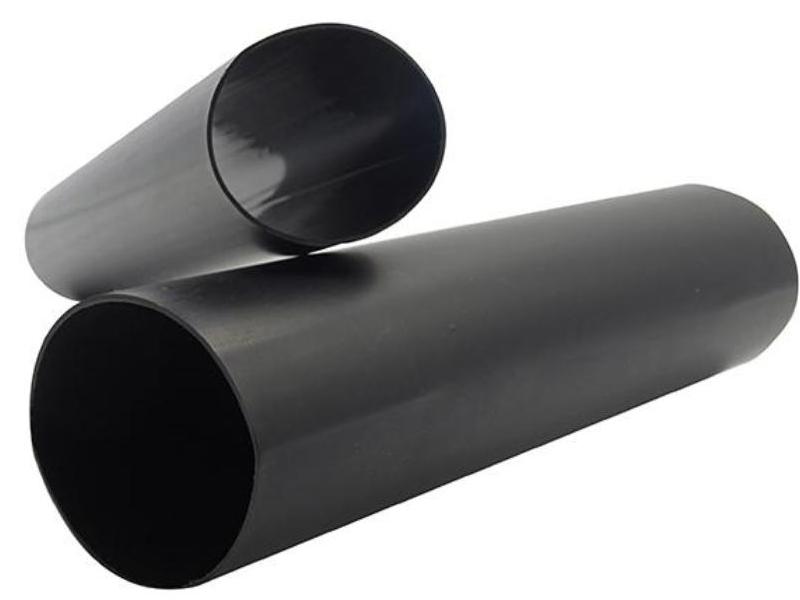
CCMT's mid-wall heat shrink tubing adopts a shrinkage ratio of 3:1. The product specifications cover different size ranges and can be used for cable joints, terminals and other connection parts. For joint structures with size variations, a high shrinkage range provides greater margin for size matching.
Bulk Procurement Should Pay More Attention to the "Specification System".
If a project involves multiple cable specifications at the same time, whether the supplier can provide a complete size series will directly affect procurement management and subsequent replenishment.
Taking CCMT's medium wall heat shrink sleeves series as an example, the products are available in multiple specifications and can be matched according to customer specific needs. If cable suppliers, engineering contractors, and cable fitting vendors know the right correlations between joint size-wire size-heat shrink tube sizes, they have an advantage of getting work done faster through the reduced need to check things.
When Making an Inquiry, You Can Send This Information Directly to the Supplier.
| Information Required | Procurement Confirmation Details |
| Cable Outer Diameter | Actual measured dimensions |
| Maximum Connector Outer Diameter | Includes terminals, connecting sleeves, etc. |
| Connector Length | Effective length requiring protection |
| Operating Environment | Indoor, outdoor, damp, or industrial environments, etc. |
| Quantity | Samples, project batches, or long-term procurement |
| Special Requirements | Color, packaging, certifications, or customization requirements |
CCMT: FromSingle Specification Supply to Project Matching.
Since 1986, CCMT has been actively involved in research and development and producing the related products. It houses a production facility covering 10,000 square meters and has over 40 production lines. For the purchase of medium wall heat shrink sleeves, CCMT not only provides products with different specifications, but also assists in matching specifications according to the cable size, joint structure and actual application needs provided by customers.
Selecting medium wall heat shrink sleeves is essentially a process of size matching and confirmation of application conditions. In some cases, the diameter of a joint can be significantly higher than the diameter of the cable or pipe being installed, which is why the maximum outer diameter of the joint as well should be measured. Apart from the diameter, you will need to determine the length, look at the changes in structure, the type of the installation and the environment where the installation takes place. Only after these basic data are correctly identified and understood, it is possible to match and use the right heat shrink tubing product.